


Lack of CBT Centres Forces Abuja Students Into Costly and Risky Journeys
By Habibat Muhammad Sani
The scorching sun is the first thing Adamu Zahradeen remembers whenever he thinks about his journey toward higher education.
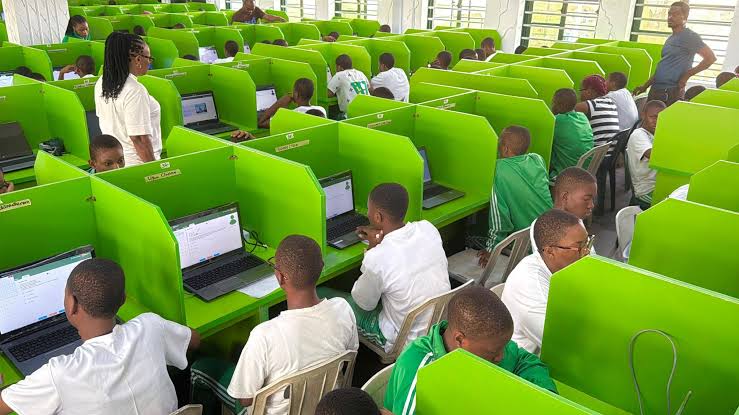
It began with a long wait by the roadside for a vehicle heading out of town.
The young aspirant, who once imagined a smooth path into tertiary education, instead embarked on a demanding journey from Kwali Area Council in Nigeria’s Federal Capital Territory to neighbouring Nasarawa State—just to sit for the 2026 Unified Tertiary Matriculation Examination (UTME).
The absence of a Computer-Based Test (CBT) centre in Kwali has turned what should be a routine examination process into a financially and emotionally draining ordeal.
“Travelling down to Nasarawa to write JAMB, especially with the increase in fuel price, is another challenge entirely,” he said.
Adamu explained that he had to arrive a day before the examination and pay for accommodation because he had no contacts in the area.
“I spent almost ₦17,000 just on transport going, and about ₦24,000 for the round trip. Then I had to pay for a hotel for the night,” he disclosed.
For him, the burden goes beyond cost—it points to a deeper systemic gap.
“The government has to do something. The most painful part is that there is no working CBT centre here in Kwali, both for registration and for the examination,” he added.
The UTME, conducted by the Joint Admissions and Matriculation Board (JAMB), remains the gateway to tertiary education in Nigeria. Candidates are required to register and sit for the examination at accredited CBT centres.
However, unlike their counterparts in other parts of the Federal Capital Territory, candidates from Abaji and Kwali Area Councils must travel to neighbouring communities—and sometimes even other states—for both registration and the examination itself.
The result is a costly and exhausting process that exposes a long-standing infrastructural gap within the FCT.
A Growing Burden of Inequality
The struggle faced by candidates like Adamu is not an isolated case.
Across Abaji and Kwali, students describe a recurring pattern of stress, financial strain, and logistical uncertainty tied to the absence of CBT centres in their communities.
Ahmad Isah, another candidate from Abaji Area Council, shared a similar experience.
“Since there is no JAMB centre in the area, it was very stressful travelling to another location just to register,” he said.
“In my case, I registered in Gwagwalada. I left home as early as 6:30 a.m., but the process did not start until 8:30 a.m., and I finished around 11:30 a.m.”
For many candidates, the ripple effect goes beyond inconvenience.
“The transport fare was high. It used to be cheaper, but now it is about ₦2,500 one way. Going and coming back is around ₦5,000, apart from bike fares,” he added.
He questioned why his community continues to be left behind.
“It is very sad that those who are not nearby are not considered. You’ll see exams scheduled for 7:00 a.m.—how is someone expected to be there by that time?”
In his case, he had to travel a day before the exam and stay with a relative in Gwagwalada.
“Something really needs to be done about this,” he said.
System Under Pressure
According to JAMB, more than 2.2 million candidates registered for the 2026 UTME, underscoring sustained pressure on Nigeria’s CBT system.
To manage this, about 980 CBT centres were accredited nationwide, each required to meet strict technical, power, and security standards.
Despite this scale, distribution remains uneven.
An analysis of JAMB’s official list shows a concentration of centres in urban locations, while Abaji and Kwali Area Councils are notably absent.
This effectively excludes students in those areas from direct access to registration and examination services within their communities.
The imbalance persists despite increased investment in education. About ₦3.52 trillion was allocated to the sector in the 2026 budget, yet infrastructural deficits and uneven access remain widespread.
More Ordeals: Travel, Delays, and Technical Failures
For many candidates, the challenges do not end with distance and cost.
Shareefdeen Umar Muhammad described repeated trips to Gwagwalada just to complete his registration.
“It took me going and coming back for two days before I was able to register. I spent almost ₦7,000,” he said.
After registration, he was posted to Kuje—an unfamiliar location—forcing him to make another trip simply to locate the centre ahead of his exam.
“I even went a day before because I didn’t want anything to go wrong,” he said.
Others have faced technical setbacks.
Amanatullah Ahmad recalled being turned back on exam day due to network failure.
“They told us we could not write and that a new date would be communicated,” she said.
She was later reposted to another centre in Apo, requiring yet another early-morning journey.
“I was never that stressed. I spent so much on transport, and the stress showed even after the exam,” she added.
For Shareefat Abdullahi, overcrowding and long travel times added to the strain.
“From Kwali, my exam was by 2:00 p.m., but I had to leave by 9:00 a.m. just to get there on time,” she said.
Getting home proved even harder.
“I got back after 8:00 p.m., even though I finished around 5:00 p.m. It was very stressful,” she said.
Parents Left to Shoulder the Burden
Parents say the situation is taking a toll on families.
“Anything that concerns JAMB is not available in Abaji unless you go to Gwagwalada,” said Halima Aliyu Sani.
“After registration, when they are posted for exams, you have to start looking for money again because of the distance.”
She added that early exam schedules often force candidates to travel a day before and pay for accommodation.
“The expenses are too much,” she said.
Another parent, Abdulrahman Amsaki, raised safety concerns.
“Our children suffer a lot. They travel long distances, spend money on transport, and sometimes accommodation,” he said.
“It is not safe, especially when they are travelling very early or coming back late.”
He called for at least two CBT centres in Kwali Area Council.
Officials Respond
Local officials say efforts are underway to address the gap.
Aisha Saad, Supervisory Councillor for Education in Abaji, told Ideko News that efforts, including a nearly completed ICT centre, are underway to address the infrastructure deficit.
“The ICT centre, which is part of preparations for JAMB, will be completed soon, Insha Allah. Once completed, there will be no cause for concern as all required arrangements are already ongoing. The Chairman is fully aware of the importance of the project and is actively overseeing its implementation,” she said.
Another official, Alhassan Isah, acknowledged the challenges faced by students.
“I am fully aware of the challenges our students face due to the absence of a JAMB CBT centre in Kwali Area Council,” he said.
He explained that establishing a CBT centre requires essential infrastructure such as computers, stable power supply, and suitable facilities that meet JAMB accreditation standards.
“The JAMB examination is computer-based nationwide, and a CBT centre cannot be established without adequate computers and a befitting structure with reliable power supply,” he noted.
Officials insist steps are being taken, though no clear timeline has been provided.
Expert Perspective: A Question of Equity
Education experts say the issue reflects a deeper problem of access and inclusion.
“This is not just an educational concern—it is a matter of equity, safety, and opportunity,” said educationist MB Suleiman.
He noted that students forced to travel long distances face financial strain, fatigue, and heightened risk.
“It is unfair that where a student lives determines their chances,” he said.
According to him, establishing CBT centres in underserved communities would reduce costs, improve safety, and enhance performance, while also boosting local development.
“The major barrier is not technical—it is prioritisation,” he added.
“Every examination cycle without adequate centres delays the future of many young Nigerians.”
As Nigeria deepens its shift to a fully digital examination system, candidates in parts of the Federal Capital Territory remain on the margins—paying more, travelling farther, and facing greater uncertainty in their pursuit of higher education.

The lack of CBT center in Abaji and kwali
Is a growing treat to life
Abaji and kwali need CBT center