


Mounting Garbage: Waste Management Crisis in Lagos
By Habibat Muhammad Sani
Lagos is generating more waste than its collection and disposal system can comfortably handle.
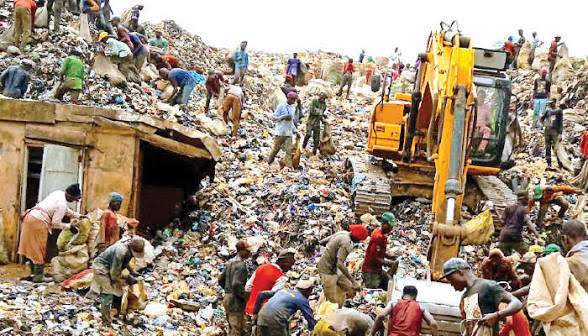
The Lagos Waste Management Authority (LAWMA) estimates that the state generates between 13,000 and 16,000 tonnes of waste every day.
The figure, released by the agency in August, came as it called for increased investment in waste collection, transportation, treatment and disposal infrastructure. LAWMA attributed the growing volume to Lagos’ estimated population of 24 million and rapid urbanisation.
A month later, the strain on the system became more visible at one of the state’s biggest disposal facilities.
At Olusosun in Ojota, long queues of waste trucks were delaying the evacuation of refuse from communities across Lagos.
During an inspection of the facility on September 9, Governor Babajide Sanwo-Olu described the situation as a “small state of emergency” and ordered the deployment of additional equipment and the reopening of other disposal sites.
The governor said some trucks were spending up to 12 hours waiting to discharge their loads at Olusosun.
With collection vehicles held up at the disposal site, fewer trucks were available to return to residential areas and evacuate accumulated refuse.
The state has since ordered 160 new compactor trucks as part of its immediate response. It also plans to increase the number of trucks able to discharge at Olusosun from about 250–350 a day to between 350 and 450.
Lagos Struggles with Rising Waste Generation
The volume of waste generated in Lagos has grown alongside its population, rapid urbanisation and changing consumption patterns.
Earlier operational data from the agency illustrates the scale of the collection effort.
In May 2026, LAWMA and its network of licensed Private Sector Participation (PSP) operators evacuated 418,500 tonnes of waste — an average of about 13,200 tonnes a day.
But the May figure does not mean all the waste generated in Lagos was collected. It records only the amount evacuated by LAWMA and its PSP operators during that month.
A World Bank assessment of Lagos’ waste management system estimated that the city generated about 13,000 tonnes of municipal solid waste each day and identified significant gaps in formal collection and disposal.
The assessment highlighted limited financial resources, infrastructure constraints and rapid urbanisation as some of the pressures facing the system.
As the city grows, the challenge is not simply generating more waste. It is ensuring that the infrastructure needed to collect, transport, process and dispose of that waste grows with it.
Collection System Faces Operational Constraints
Lagos’ household waste collection system depends heavily on licensed private operators working under LAWMA’s Private Sector Participation scheme.
Under the arrangement, private operators are responsible for collecting waste from homes and businesses, while LAWMA oversees and regulates the system and manages disposal infrastructure.
The model depends on trucks being able to complete the full cycle — from collecting waste in communities, to discharging it at a disposal facility, and returning in time for another round of collection.
The congestion at Olusosun exposed a weakness in that chain.
Sanwo-Olu said the limited number of tipping points at the facility was slowing the discharge of trucks.
The government plans to increase the number of tipping points from two or three to four or five in an effort to improve truck turnaround times.
The state is also working to reactivate four other disposal sites: Solu 3 in Alimosho, Iwulepe in Ikorodu, Oke Osho in Epe and Erikitte in Badagry.
The latest government intervention also includes a 2,400-metric-tonne transfer loading station planned for Olusosun. Another facility of the same capacity is planned for Solu 3.
The government says the transfer stations will receive compacted waste before it is moved to material recovery facilities for sorting and further processing.
Material recovery facilities are also planned at Oke Osho in Epe and Erikitte in Badagry.
These projects form part of the state’s longer-term effort to reduce pressure on disposal sites and increase the amount of waste recovered for recycling and processing.
But infrastructure is only one part of the challenge.
Illegal Dumping Adds to the Pressure
Indiscriminate dumping continues to add to Lagos’ waste burden.
Waste discarded along roads, in open spaces and in drainage channels can remain outside the formal collection system until it is removed by enforcement teams or special clean-up operations.
LAWMA has continued to target illegal dumping and unregistered waste activities through enforcement operations.
But the availability and accessibility of formal collection services also matter.
In a 2025 study of waste management in Lagos, the World Bank reported that 70 per cent of surveyed residents expressed interest in a service that would collect waste directly from their homes.
The same study found that 80 per cent of respondents generated plastic waste mainly from food packaging and shopping bags.
The findings point to two sides of the problem: how residents dispose of waste and how accessible and convenient formal collection services are.
For a city generating thousands of tonnes of waste every day, gaps in either part of the system can quickly become visible on the streets.
Plastic Waste Threatens Lagos Waterways
Much of the waste accumulating in Lagos is plastic.
A United Nations Environment Programme (UNEP) audit found that about 34 kilogrammes of plastic waste per person per year was leaking into Lagos’ water system.
The audit was carried out with Lagos State and UN-Habitat to establish the scale and sources of plastic pollution in the city.
The findings have implications for Lagos’ drainage and water systems.
Plastic waste discarded on roads or in open spaces can be carried into drains during rainfall and eventually find its way into canals, lagoons and other waterways.
For a city that experiences heavy seasonal rainfall, blocked drainage channels can compound the risk of flooding.
The problem has already influenced state policy.
UNEP reported that findings from the plastic audit contributed to the Lagos government’s 2024 decision to ban single-use food containers made from polystyrene foam.
But restrictions alone cannot address the volume of plastic entering the waste stream.
The question is what happens to that waste after it is discarded.
Recycling Remains Part of the Solution
The growing volume of waste has strengthened the case for recycling and waste recovery.
The World Bank has identified recycling and improved waste separation as important components of a more sustainable waste management system in Lagos.
Its research also found widespread generation of plastic waste from food packaging and shopping, making plastics a significant target for recovery.
The state’s planned material recovery facilities are intended to support that transition.
Rather than sending all collected waste directly to disposal sites, recyclable materials can be separated and processed for reuse.
That could reduce the volume reaching already pressured disposal facilities while creating opportunities across the recycling value chain.
But building that system requires more than recycling facilities.
It also depends on collection, sorting, public participation, enforcement and a market for recovered materials.
For Lagos, the challenge is therefore both immediate and long-term.
The immediate concern is getting waste off the streets and ensuring collection trucks can keep moving.
The longer-term challenge is building a system capable of managing the waste generated by a rapidly growing city — while reducing the amount that ultimately needs to be buried or dumped.
Lagos’ waste problem is no longer simply about the refuse visible along its streets.
It is a question of whether the city’s collection, disposal and recycling infrastructure can keep pace with its growth.
Until those capacities consistently match the volume of waste being generated, the mounting garbage will remain more than a sanitation problem.
It will be a continuing test of how Lagos manages the demands of being one of Africa’s biggest and fastest-growing cities.
