


Nigeria’s Tinubu Faces Divided Opposition Ahead of 2027 Polls
Samuel Danbaji – Jos, Nigeria.
Nigeria’s 2027 presidential election campaign has officially begun, setting the stage for a contest that will determine whether President Bola Ahmed Tinubu wins a second term or a divided opposition can unseat the ruling All Progressives Congress.
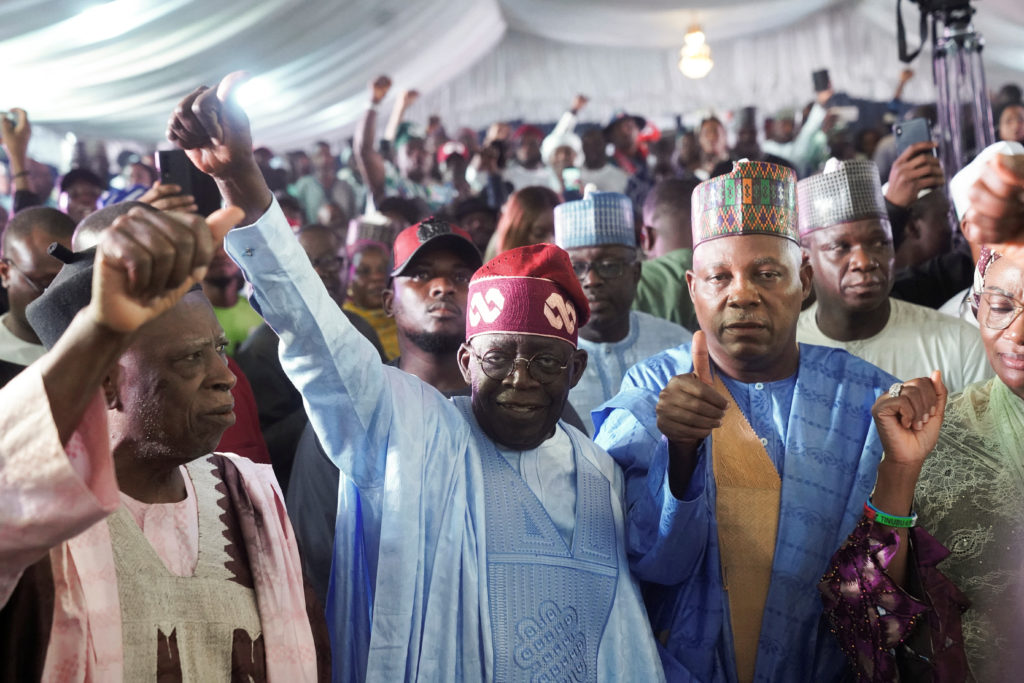
The Independent National Electoral Commission, INEC, set August 19 as the start of campaigns for the presidential and National Assembly elections. The polls are scheduled for January 16, 2027, while campaigns for governorship and state assembly elections will begin on September 9.
Political parties have been mobilising supporters and holding consultations for months, but August 19 marked the beginning of the formal campaign period under INEC’s electoral timetable.
INEC’s published list contains 19 presidential candidates, including incumbent President Tinubu of the APC, former Vice-President Atiku Abubakar of the African Democratic Congress, and former Anambra State governor Peter Obi of the New Democratic Congress.
The crowded field, however, does not mean that all the candidates have comparable political reach, structures or resources.
The election is already being shaped by the three leading figures from the 2023 contest — Tinubu, Atiku and Obi — while the opposition’s failure to unite behind a single challenger could prove decisive.
Atiku and Obi have both been involved in efforts to build a broad opposition coalition, but those efforts have so far failed to produce a single presidential ticket.
That leaves the opposition facing an incumbent who has spent more than three years consolidating political alliances across the country.
Tinubu’s second-term test
Tinubu enters the campaign seeking another four-year term after a first administration dominated by major economic reforms.
His government removed the petrol subsidy and introduced significant currency reforms — measures welcomed by some investors and economists but which have also placed severe pressure on household incomes.
Reuters reported this week that nearly 80% of Nigerians believe the country is moving in the wrong direction, with economic hardship and insecurity among voters’ biggest concerns.
The report also said more than 10,000 people have been killed by armed groups since Tinubu took office, while kidnappings remain a major security concern.
The cost-of-living crisis is therefore likely to be central to the campaign.
Opposition parties are expected to argue that Tinubu’s reforms have placed too much pressure on ordinary Nigerians. The administration, meanwhile, is likely to point to increased government revenues, improved investor confidence and the longer-term benefits it says will come from the reforms.
Despite public dissatisfaction reflected in opinion polling, Tinubu enters the race with significant political and institutional advantages.
According to the Associated Press, 31 of Nigeria’s 36 state governors are now members of the APC following a series of political defections.
That gives the ruling party a formidable grassroots structure and political networks across much of the country.
Why opposition unity matters
The opposition’s fragmentation could therefore become one of the most important factors in the election.
In 2023, Tinubu won the presidency with 8,794,726 votes, or 36.61% of the votes cast.
Atiku received 29.07%, while Obi won 25.40%.
The combined vote share of Atiku and Obi was considerably higher than Tinubu’s total. But Nigeria’s electoral system does not allow votes for different opposition candidates to be combined automatically, and Tinubu secured the highest number of votes while meeting the constitutional requirements to win.
That history explains why opposition unity has remained a central issue throughout preparations for 2027.
The challenge for Atiku, Obi and other opposition figures is not simply winning support individually, but finding a way to consolidate enough of that support behind a single candidate capable of defeating the incumbent.
So far, that has proved difficult.
A huge electorate
The election will also take place before a very large electorate.
Nigeria’s voter register contained 93,469,008 registered voters for the 2023 general election, including more than 37 million voters aged between 18 and 34.
INEC is working to clean and revalidate the register ahead of 2027, citing concerns including duplicate registrations, underage registration, deceased voters and inaccurate records.
The commission has stressed that the credibility of the voters’ register is fundamental to public confidence in the election.
For the parties, the challenge will therefore extend beyond filling campaign venues and mobilising supporters.
They will need to persuade millions of voters — particularly younger Nigerians facing unemployment, rising living costs and insecurity — that their candidate can deliver tangible improvements.
Economy, security and governance
The campaign is expected to revolve around three broad questions: Can Tinubu’s economic reforms deliver meaningful improvements in living standards? Can his government contain insecurity? And can the opposition present a credible alternative?
The APC will campaign on the argument that difficult reforms were necessary to correct longstanding economic distortions.
Opposition parties are likely to counter that Nigerians should judge the administration by the immediate impact of those policies on food prices, purchasing power, jobs and household welfare.
Security will be another major battleground, particularly in northern states affected by terrorism, banditry and kidnapping.
The government will face pressure to demonstrate that its security strategy is producing measurable improvements rather than simply announcing new operations.
Governance and democratic accountability are also likely to feature prominently.
Civil society organisations have already urged presidential candidates to make commitments on transparency, including public declarations of assets and opposition to vote buying.
Can the opposition overcome its divisions?
Claims that Tinubu is already certain to win a second term should be treated as political predictions rather than established fact.
His administration enters the race with considerable advantages: incumbency, control of the federal government, a powerful party structure and support among many political elites.
But the president also faces genuine vulnerabilities, particularly public frustration over economic hardship and insecurity.
The opposition, meanwhile, has significant potential electoral strength but remains divided.
The 2027 contest may ultimately turn on whether that fragmentation persists and whether voters judge Tinubu’s reforms by their longer-term promise or by their immediate economic cost.
With the formal campaign now underway, the political battle is entering its most visible phase.
In the roughly five months before the January 16 vote, Tinubu and his challengers will have to convince Nigerians that they have the answers to the country’s most pressing problems — and give voters a reason to turn out for them.
