


Robots Take to Warsaw Streets in Unusual Protest for AI Regulation
Around 30 robots marched through the streets of Warsaw on Monday, waving flags and broadcasting protest slogans in an unusual demonstration calling for stronger regulation of artificial intelligence and greater protection for workers threatened by automation.
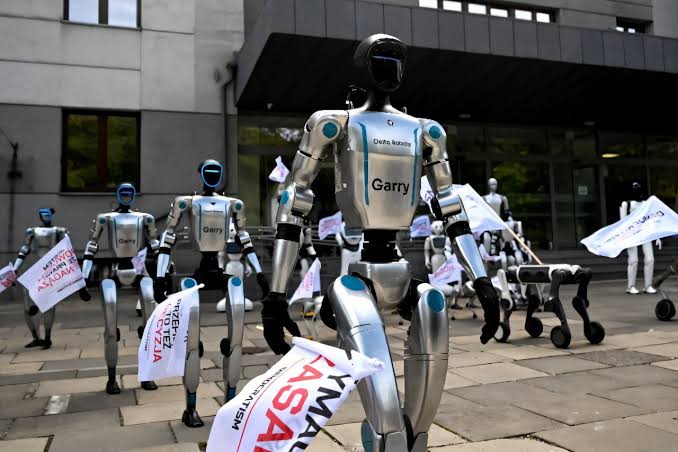
The demonstration, held outside Poland’s Ministry of Digital Affairs, was organised by Democratism, an initiative focused on raising public debate about the impact of artificial intelligence and robotics on employment.
The machines included humanoid robots as well as dog-like quadrupeds. Loudspeakers played messages including “Defend workplaces,” “Time for rules” and “Don’t wait, regulate” as the robots moved around the demonstration area.
Organiser Grzegorz Kulis said the unusual protest was designed to demonstrate that advanced robotics is no longer a distant concept and to draw attention to the potential displacement of workers.
He argued that regulations are needed to protect employees as AI-powered machines become increasingly capable of performing both physical and cognitive tasks.
The demonstration also attracted Poland’s Digital Affairs Minister Krzysztof Gawkowski, who met with the organiser. Gawkowski warned that uncontrolled AI models integrated into increasingly sophisticated humanoid robots could become a major concern as robotisation advances.
The protest comes as Poland is putting in place its national framework for implementing the European Union’s AI Act, the bloc’s landmark legislation regulating artificial intelligence. Poland’s government says the new framework is intended to strengthen the safety of AI systems while supporting technological innovation.
Poland’s parliament has also been working on establishing a national body responsible for supervising AI systems and implementing the EU rules.
While the robots were not independently organising a labour movement, their appearance offered a striking visual representation of the debate surrounding AI: the technology that could transform workplaces is increasingly becoming capable of physically demonstrating the concerns surrounding its own impact.
