


Africa’s Migration Paradox: Closing Doors to Africans, Opening Them to US Deportees
By Habibat Muhammad Sani
Across Africa, migration is becoming an increasingly political fault line.
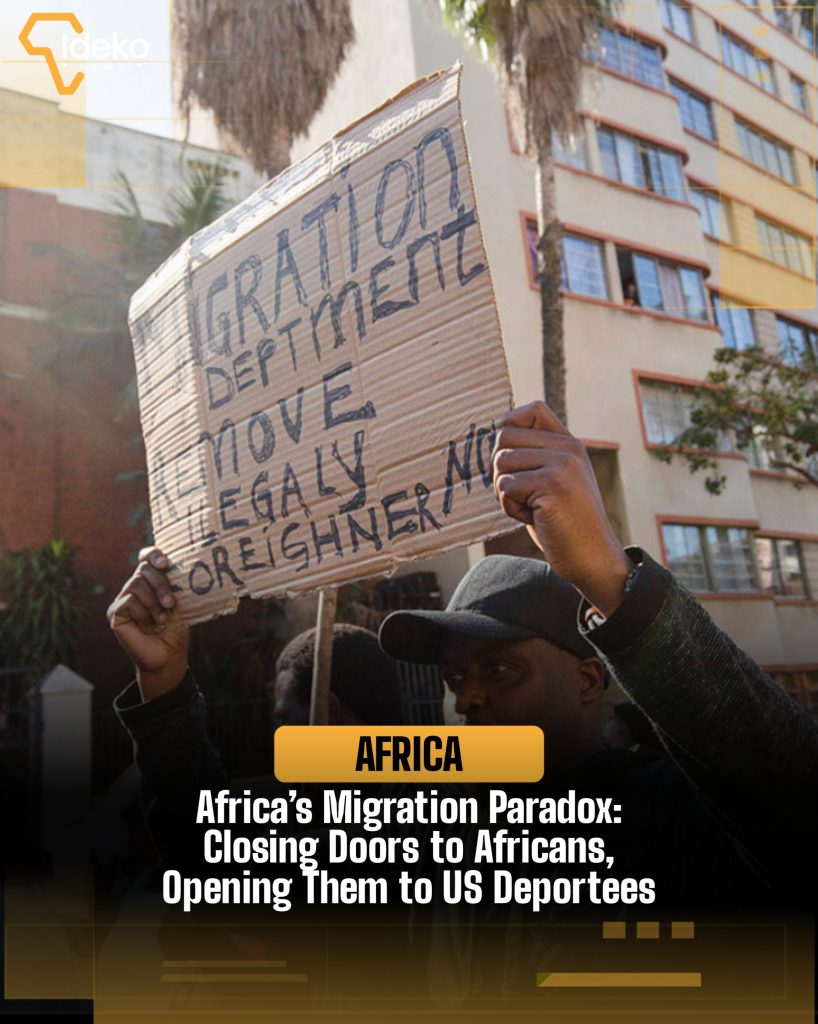
Governments are under growing pressure to protect jobs and businesses for their citizens, while public frustration over unemployment and economic hardship is increasingly being directed at foreign nationals.
Yet, at the same time, some African governments are opening their borders to migrants deported by wealthier countries, particularly the United States.
Kenya offers the latest example.
President William Ruto has ordered a crackdown on foreign nationals operating small-scale businesses and hawking, arguing that such activities should be reserved for Kenyans.
The directive took effect on September 7, prompting concern among migrant communities, including Burundians living and working in Nairobi.
The government says foreigners with valid permits remain protected by law. But the policy has nevertheless intensified a broader debate over the place of migrants in Kenya’s economy.
Kenya is not alone.
South Africa has also experienced renewed anti-immigrant mobilisation, with African migrants accused of taking jobs and business opportunities from citizens. Rights groups, including Human Rights Watch and the African Commission on Human and Peoples’ Rights, have raised concerns about violence and intimidation targeting foreign nationals.
The reasons behind these tensions are not difficult to understand.
Across much of the continent, governments are grappling with high unemployment, weak economies, pressure on public services and growing demands from citizens for greater access to jobs and opportunities.
Foreign traders and migrants can consequently become convenient symbols of economic frustration.
Governments have a legitimate responsibility to regulate immigration and protect local economic interests. But blaming migrants for structural economic problems risks turning legitimate policy debates into xenophobia.
And that makes Africa’s simultaneous role as a source of anti-migrant sentiment and a destination for foreign deportees particularly striking.
The United States has increasingly relied on third-country deportations, sending migrants to countries that are neither their countries of citizenship nor necessarily places with which they have any meaningful connection.
Liberia recently agreed to receive up to 1,200 deportees from the US, beginning with 20 people in August.
Similar arrangements have involved countries including Ghana, Sierra Leone, Rwanda and Cameroon.
Liberia says the arrangement is humanitarian, and that deportees can seek asylum or leave the country. It has also acknowledged that it will receive unspecified support to manage the programme.
Money, however, is an important part of the wider story.
A US Senate report previously found that Washington had spent more than $40 million on third-country deportations involving about 300 migrants, with some African governments receiving millions of dollars under individual arrangements.
That does not mean every African country accepting deportees is being paid directly to take them.
Ghana, for instance, has maintained that its decision was based on humanitarian and regional considerations.
But the financial and diplomatic incentives surrounding these agreements cannot simply be ignored.
For governments facing economic pressures, cooperation with Washington can offer diplomatic and financial benefits.
For the United States, meanwhile, agreements with African countries provide an alternative destination for migrants it wants removed but cannot easily return to their countries of origin.
That arrangement raises difficult questions about power.
Some deportees are asylum seekers or people with legal protections against being returned to countries where they could face persecution or torture.
Rights organisations have therefore warned that transferring such people to a third country could create another route towards refoulement, particularly where the receiving country’s legal and humanitarian safeguards are weak.
Africa’s migration dilemma, therefore, is not simply about whether African countries are welcoming or rejecting foreigners.
It is about who is allowed to move, under what conditions and for whose benefit.
The same continent that speaks passionately about Pan-Africanism and regional integration is struggling with the reality that an African trader can cross a border in search of opportunity and suddenly become a political problem.
Yet another African government can simultaneously negotiate with a global power to receive people that power no longer wants.
There is nothing inherently wrong with countries enforcing immigration laws, protecting local businesses or entering migration agreements.
The concern begins when economic hardship turns migrants into scapegoats, or when vulnerable deportees become bargaining instruments in relationships between unequal states.
Africa’s migration debate therefore demands something more than tighter borders or open-border rhetoric.
It requires transparent agreements, consistent application of the law and, above all, protection of human dignity.
If African governments genuinely want an integrated continent, the question cannot only be how to protect Africans from foreign competition.
It must also be how to ensure that Africans do not become foreigners to one another.
